Special Issue: Journal of Folklore Research (JFR)

  1. Home
  2. /
  3. CALL FOR PAPERS
  4. /
  5. Special Issue: Journal of...

Special Issue: Journal of Folklore Research (JFR)

Vernacularity, Folk Practices, and Indigenous Knowledge Systems in Contemporary Contexts

Overview

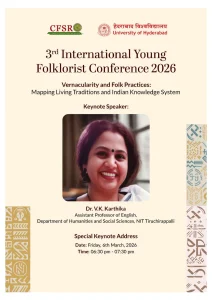
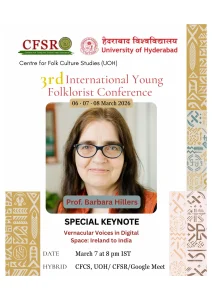
This special issue grows out of the international conference Vernacularity and Folk Practices (March 5–8, 2026), organized by the Centre for Folk Culture Studies (CFCS) at the University of Hyderabad and the Centre for Folklore Studies and Research (CFSR). It looks at vernacularity and folk practices as living, changing ways of knowing that help communities make sense of and respond to ongoing social, technological, and environmental changes. Rather than treating tradition as something fixed, the issue highlights vernacular knowledge as an active, evolving framework that supports cultural continuity, adaptation, and resilience.

The issue invites interdisciplinary contributions engaging with digital cultures, artificial intelligence, sustainability, and indigenous knowledge systems, with particular attention to Global South contexts while encouraging comparative and global perspectives.

Thematic Areas

  • Vernacular Worlds: Oral traditions, language, identity, and cultural transmission
  • Folk Knowledge and Indigenous Knowledge Systems: Epistemologies, legitimacy, and knowledge hierarchies
  • Healing Practices: Folk medicine, spirituality, and public health
  • Ecology and Sustainability: Agroecology, climate adaptation, and environmental ethics
  • Applied Folklore: Cultural policy, heritage, and public engagement
  • Digital Vernaculars and AI: Platform cultures, algorithmic mediation, and online expression
  • Knowledge Custodians: Grassroots practitioners and intellectual histories

Submissions may also address:

  • Decolonial and postcolonial critiques of knowledge production
  • Gender, caste, and marginality in folk traditions
  • Mobility, migration, and transnational vernacular cultures
  • Ethics, representation, and digital archiving

Submission Guidelines

  • Article Length: 6,000–8,000 words (including references and footnotes)
  • Abstract: 200 words outlining the argument, methodology, and findings
  • Keywords: Five keywords
  • Author Bio: 50 words including institutional affiliation
  • Citation Style: Chicago Manual of Style (17th edition)

All submissions must be original and will undergo a double-blind peer review process.

Important Dates

  • Abstract Submission Deadline: 30 June 2026
  • Notification of Acceptance: 10 July 2026
  • Full Paper Submission Deadline: 10 September 2026
  • Peer Review Feedback: 1 December 2026
  • Final Submission (Revised Papers): 1 February 2027
  • Tentative Publication: May 2027

Submission Process

Submissions should be sent via email to: editorialcfcscfsr@gmail.com

Subject Line: Special Issue Submission: [Paper Title]

For abstract submission, include the abstract, keywords, and author bio in the body of the word document.  Full papers should be submitted as a single word file, including all required components in accordance with journal guidelines.

For more details follow the link- https://scholarworks.iu.edu/journals/index.php/jfr/about/submissions#authorGuidelines


Publication Opportunities

The best-selected papers that meet the journal’s standards will be published in the Journal of Folklore Research. Other high-quality submissions may be considered for publication in an edited volume by the Centre for Folk Culture Studies (CFCS) and the Centre for Folklore Studies and Research (CFSR). We invite contributions from scholars across disciplines and look forward to engaging with diverse perspectives on vernacular knowledge systems in contemporary contexts.

Note: Invitations to submit a full paper do not guarantee final publication, as full manuscripts will undergo the peer review process.

Guest Editors:

Dr. Deepika Kashyap (SRM IST Tamil Nadu, India),

Dr. Md Intaj Ali (Netaji Subhas Open University, West Bengal, India)


Leave a Comment

Your email address will not be published. Required fields are marked *

Scroll to Top